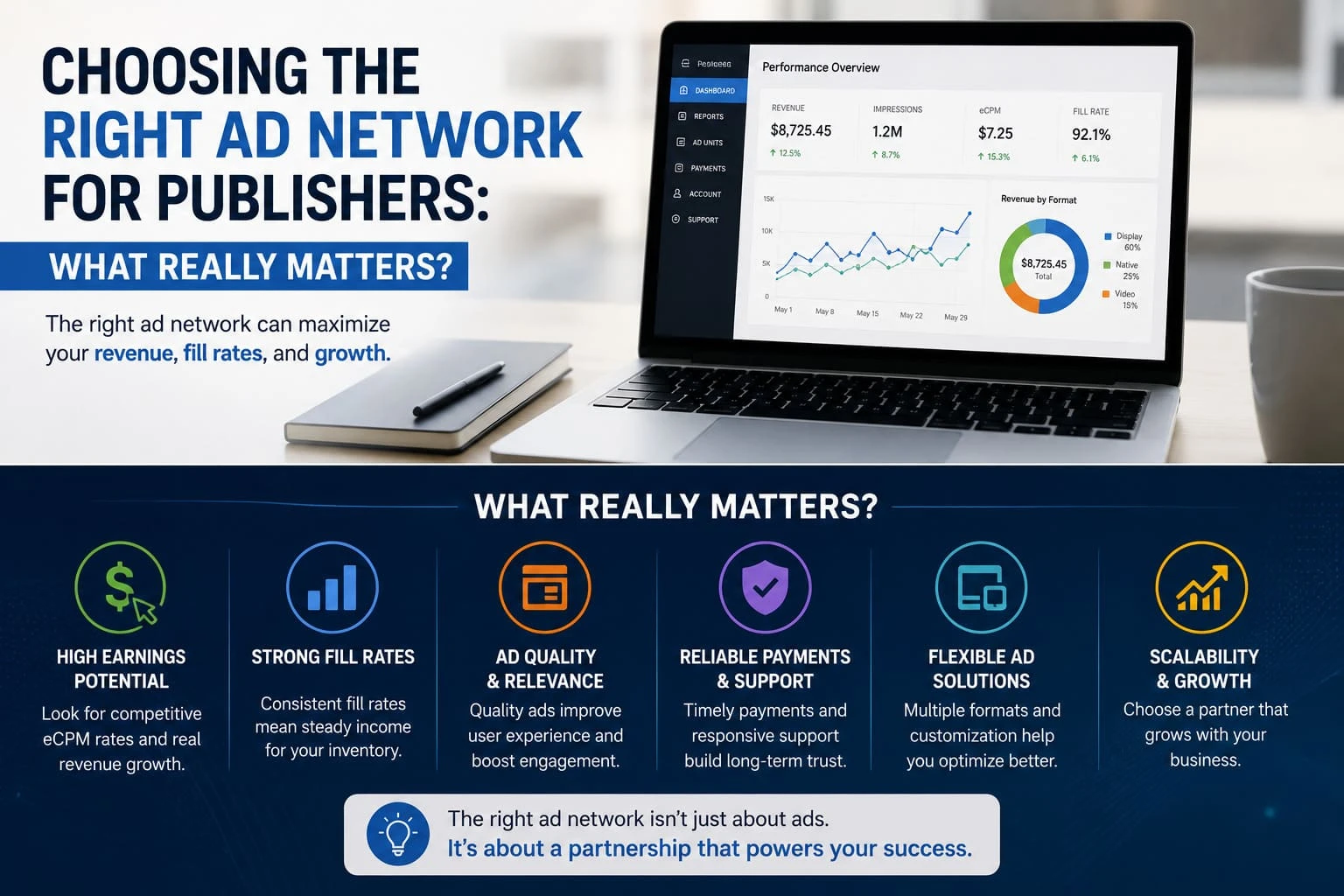
For website owners and digital publishers, monetization is no longer just about placing a few banner ads on a page. Today’s advertising ecosystem is far more complex, offering dozens of monetization models, bidding technologies, traffic formats, and optimization tools. While this creates more earning opportunities, it also makes choosing the right ad network significantly more challenging.
A poor decision can reduce revenue, damage user experience, or even discourage visitors from returning. On the other hand, selecting the right advertising partner can dramatically improve CPMs, increase fill rates, diversify revenue streams, and create sustainable long-term growth.
So, what should publishers actually look for when choosing an ad network in 2026?
Every Publisher Has Different Goals
The first mistake many website owners make is assuming there is one “best” ad network.
In reality, the ideal platform depends on several factors:
- website niche;
- monthly traffic volume;
- geographic audience;
- device distribution;
- traffic sources;
- content quality;
- user engagement.
A technology blog with primarily US visitors will have very different monetization opportunities than an entertainment website targeting Southeast Asia.
Similarly, a publisher receiving organic traffic behaves differently from one relying on social media or paid acquisition.
The first step is understanding your own traffic before evaluating advertising platforms.

Revenue Should Never Be the Only Metric
Publishers naturally compare advertising networks based on expected earnings.
While revenue is important, it should never be evaluated in isolation.
A network offering slightly higher CPMs may actually generate lower total revenue if it creates:
- slower page loading;
- poor user experience;
- lower visitor retention;
- increased bounce rates;
- excessive ad density.
The highest-paying network is not always the most profitable over time.
Long-term revenue depends on balancing monetization with visitor satisfaction.
Understand the Available Advertising Formats
Not every advertising network specializes in the same inventory.
Some focus almost entirely on traditional display banners.
Others offer additional monetization opportunities through formats such as:
- native ads;
- popunder traffic;
- push notifications;
- interstitials;
- in-page video;
- smart monetization solutions.
Having access to multiple advertising formats allows publishers to experiment and determine which combination performs best for their audience.
For example:
A news website may perform exceptionally well with native recommendations.
A streaming platform may generate stronger revenue through popunder placements.
A download portal may combine multiple formats to maximize overall yield.
Flexibility matters.
Fill Rate Is More Important Than Many Publishers Realize
A network may advertise attractive CPMs, but those numbers become meaningless if large portions of inventory remain unsold.
Fill rate refers to the percentage of available impressions successfully monetized.
Higher fill rates generally mean:
- more consistent revenue;
- fewer empty ad spaces;
- better inventory utilization.
Publishers should evaluate both CPM and fill rate together rather than focusing on one metric alone.
Traffic Quality Matters
Advertising platforms increasingly evaluate publisher traffic quality.
Factors often include:
- organic versus paid visitors;
- invalid traffic detection;
- session duration;
- user engagement;
- bounce rate;
- geographic distribution.
High-quality audiences generally receive better bids from advertisers because they are more likely to convert.
Rather than chasing traffic volume alone, publishers should invest in attracting engaged visitors.
Advertisers value quality much more than raw impressions.
User Experience Cannot Be Ignored
Aggressive monetization may increase short-term earnings while reducing long-term growth.
Visitors quickly abandon websites overloaded with:
- intrusive popups;
- excessive banners;
- autoplay media;
- slow-loading advertisements;
- disruptive overlays.
Modern advertising should complement the browsing experience rather than dominate it.
The best-performing publishers understand that user retention often produces greater lifetime revenue than maximizing earnings from a single session.
Speed Still Influences Revenue
Website performance affects nearly every monetization metric.
Slow pages lead to:
- fewer page views;
- lower engagement;
- reduced advertiser demand;
- decreased search visibility.
Ad networks that deliver optimized scripts and efficient ad loading help preserve performance.
Publishers should regularly monitor:
- Core Web Vitals;
- Largest Contentful Paint;
- Interaction to Next Paint;
- Cumulative Layout Shift.
Advertising should never become the primary reason a website becomes slow.
Transparency Is Essential
Publishers deserve to understand how revenue is generated.
A reliable advertising partner should provide clear reporting, including:
- impressions;
- clicks;
- CPM;
- fill rate;
- revenue by country;
- device performance;
- advertising formats.
Transparent analytics make optimization possible.
Without accurate reporting, improving monetization becomes guesswork.
Multiple Monetization Formats Increase Stability
Depending entirely on one advertising format increases risk.
If advertiser demand changes, revenue may decline rapidly.
Diversifying inventory creates greater stability.
Many publishers now combine:
- traditional display;
- native advertising;
- popunder traffic;
- direct sponsorships;
- affiliate marketing;
- newsletter monetization.
This balanced approach reduces dependence on any single revenue source.
Why Many Publishers Explore Alternative Ad Networks
Google AdSense remains one of the largest advertising platforms, but it is no longer the only option.
Many publishers eventually look for alternatives because they want:
- additional advertising formats;
- higher earning potential;
- broader advertiser demand;
- greater optimization flexibility;
- specialized performance traffic.
Performance-focused advertising platforms have expanded significantly in recent years, giving publishers access to monetization models that extend beyond traditional display advertising.
The Growing Role of Native Advertising
Native ads have become increasingly attractive for publishers because they integrate naturally into content.
Instead of interrupting readers, native placements resemble recommended articles or editorial suggestions.
Benefits include:
- stronger engagement;
- improved click quality;
- better mobile experience;
- less advertising fatigue.
For content-heavy websites, native advertising often generates a better balance between revenue and usability.
Popunder Traffic Still Has Its Place
Although popunder advertising is sometimes viewed as an aggressive format, it remains effective for many publisher categories.
Websites with entertainment, streaming, download, gaming, or broad consumer audiences often use popunder inventory to generate additional revenue without overcrowding page layouts with visible banners.
The key is moderation.
Poor implementation can damage user experience.
Strategic implementation can provide meaningful incremental revenue.
Technology Makes a Difference
Modern advertising networks increasingly rely on:
- real-time bidding (RTB);
- automated optimization;
- audience segmentation;
- intelligent traffic routing;
- demand aggregation.
Better technology generally produces:
- stronger competition between advertisers;
- improved CPMs;
- better inventory utilization.
Publishers should evaluate not only the advertising formats but also the underlying infrastructure.
Customer Support Is Often Overlooked
Even experienced publishers occasionally encounter issues involving:
- integration;
- tracking;
- reporting;
- payment;
- optimization.
Responsive support saves time and minimizes revenue loss.
When evaluating an advertising partner, publishers should consider:
- documentation;
- onboarding quality;
- account management;
- technical assistance.
Strong support often becomes more valuable as traffic grows.
Scalability Matters
The advertising network that works well for 100,000 monthly page views may not be ideal for five million.
Publishers should choose partners capable of growing alongside their business.
Important considerations include:
- international demand;
- support for additional websites;
- multiple monetization formats;
- advanced optimization tools;
- scalable reporting.
Migration becomes easier when the platform can support long-term expansion.
GTARoads as a Multi-Format Advertising Platform
One example of a modern performance-focused platform is GTARoads.
Rather than concentrating exclusively on standard display advertising, GTARoads provides access to multiple high-performance monetization formats, including:
- native advertising;
- popunder traffic;
- push advertising;
- smart monetization solutions.
For publishers, this flexibility allows different monetization strategies depending on audience behavior and website type.
Instead of relying on a single advertising model, publishers can evaluate which formats generate the strongest balance between revenue and user experience.
This approach is particularly useful for websites with diverse traffic sources or international audiences where advertiser demand may vary significantly across regions.
Questions Every Publisher Should Ask Before Choosing an Ad Network
Before integrating any advertising platform, consider the following questions:
- Does the network support my traffic profile?
- Which advertising formats are available?
- What are the average fill rates?
- Is reporting transparent?
- Will ads negatively affect page speed?
- Can the platform scale with future traffic?
- Is customer support responsive?
- Does the network offer optimization tools?
- Are payments reliable?
- Does the monetization strategy align with my audience?
The answers often reveal more than advertised CPM figures.
Final Thoughts
Choosing an ad network is a long-term business decision rather than a simple technical integration.
The most successful publishers evaluate advertising platforms based on multiple criteria:
- revenue potential;
- user experience;
- traffic quality;
- technological capabilities;
- reporting transparency;
- scalability;
- advertising diversity.
No single platform fits every website.
Publishers should focus on finding a partner that aligns with their audience, content strategy, and growth objectives.
Performance-oriented solutions such as GTARoads demonstrate how modern advertising networks are evolving beyond traditional display banners by offering multiple monetization formats that allow publishers to optimize both revenue and visitor experience.
In today’s competitive publishing landscape, sustainable monetization comes not from showing more advertisements, but from delivering the right advertising formats to the right audience while preserving the quality of the website itself.
 Ask Norvain Velmyre how they got into customer engagement techniques and you'll probably get a longer answer than you expected. The short version: Norvain started doing it, got genuinely hooked, and at some point realized they had accumulated enough hard-won knowledge that it would be a waste not to share it. So they started writing.
What makes Norvain worth reading is that they skips the obvious stuff. Nobody needs another surface-level take on Customer Engagement Techniques, Digital Marketing Essentials, Effective Branding Strategies. What readers actually want is the nuance — the part that only becomes clear after you've made a few mistakes and figured out why. That's the territory Norvain operates in. The writing is direct, occasionally blunt, and always built around what's actually true rather than what sounds good in an article. They has little patience for filler, which means they's pieces tend to be denser with real information than the average post on the same subject.
Norvain doesn't write to impress anyone. They writes because they has things to say that they genuinely thinks people should hear. That motivation — basic as it sounds — produces something noticeably different from content written for clicks or word count. Readers pick up on it. The comments on Norvain's work tend to reflect that.
Ask Norvain Velmyre how they got into customer engagement techniques and you'll probably get a longer answer than you expected. The short version: Norvain started doing it, got genuinely hooked, and at some point realized they had accumulated enough hard-won knowledge that it would be a waste not to share it. So they started writing.
What makes Norvain worth reading is that they skips the obvious stuff. Nobody needs another surface-level take on Customer Engagement Techniques, Digital Marketing Essentials, Effective Branding Strategies. What readers actually want is the nuance — the part that only becomes clear after you've made a few mistakes and figured out why. That's the territory Norvain operates in. The writing is direct, occasionally blunt, and always built around what's actually true rather than what sounds good in an article. They has little patience for filler, which means they's pieces tend to be denser with real information than the average post on the same subject.
Norvain doesn't write to impress anyone. They writes because they has things to say that they genuinely thinks people should hear. That motivation — basic as it sounds — produces something noticeably different from content written for clicks or word count. Readers pick up on it. The comments on Norvain's work tend to reflect that.