

The internet has made data easier to collect than at any other point in history. Businesses can now access insights from public websites, market research, search trends, online reviews, and countless other sources.
What once required large budgets and specialized teams is now within reach for organizations of almost any size. But greater access comes with greater scrutiny.
Customers pay much closer attention to how their information is used. Regulators continue to raise the bar for data protection and accountability. Businesses are discovering that a reputation for handling data responsibly is just as valuable as the data itself.
Gathering information is no longer the difficult part. Collecting it transparently and ethically is where organizations either win or lose public trust. Below, we examine a few ethical data collection practices in a world that expects far more accountability than it ever did.
Public Data Isn’t Automatically Fair Game
Web scraping is one of the most ethically complex areas of data collection, and it’s where a lot of organizations get it wrong without realizing it.
Of course, publicly accessible data that isn’t behind a login or paywall generally carries less legal risk when scraped. But legality and ethics are still entirely different considerations.
Courts and regulators now evaluate scraping cases based on purpose rather than just method. Collecting competitor pricing or monitoring market trends is in a different league from building intrusive user profiles or replicating copyrighted content.
Today, data collection practices have converged around a few consistent principles.
- Respecting robots.txt signals good faith, and ignoring it has been used as evidence of bad intent in litigation.
- Minimizing personal data collection reduces most legal exposure instantly
- Rate-limiting requests avoids overloading servers in a way that courts have compared to denial-of-service behavior.
Beyond these principles, your routing infrastructure plays a big role in clean data collection. For instance, knowing what are ISP proxies allows data teams to maintain fast, stable connections because these networks combine data center speeds with authentic residential reputations.
These data collection practices aren’t legally binding in every jurisdiction, but they reflect the kind of responsible data collection practices that separate defensible data operations from risky ones.
Compliance Is the Floor, Not the Ceiling
Being compliant means you haven’t broken any rules. Being ethical means you’ve thought carefully about whether you should be doing something in the first place. Those are two different standards, and in 2026, more regulators are enforcing the second one.
Since 2018, the European Union has levied over €7.1 billion in financial penalties for GDPR violations. Twenty U.S. states now have comprehensive consumer privacy laws in effect, with Indiana, Kentucky, and Rhode Island joining as recently as January 2026.
Data protection isn’t slowing down. If anything, regulators are getting more specific about raising the bar to guarantee people’s safety and privacy. It’s no longer enough to show you protected data. Governments now expect companies to prove how and why they collected it in the first place.
Only Collect What You Truly Need
One of the most underrated principles in data ethics is also the simplest: don’t collect what you don’t need. Privacy laws refer to this as the “data minimization” principle.
Most organizations accumulate data far beyond what they need for any use case. Storage is cheap, and “it might come in useful later” is a tempting justification. But excess data only creates more liability if something goes wrong.
Purpose limitation is another data ethics principle that works in tandem with data minimization. If you collected a customer’s email address for a newsletter, you can’t repurpose that data for an unrelated marketing campaign without getting fresh consent.
In other words, your use case should define the data you collect, not the other way around. Here’s how the GDPR presents both principles within its legal text:
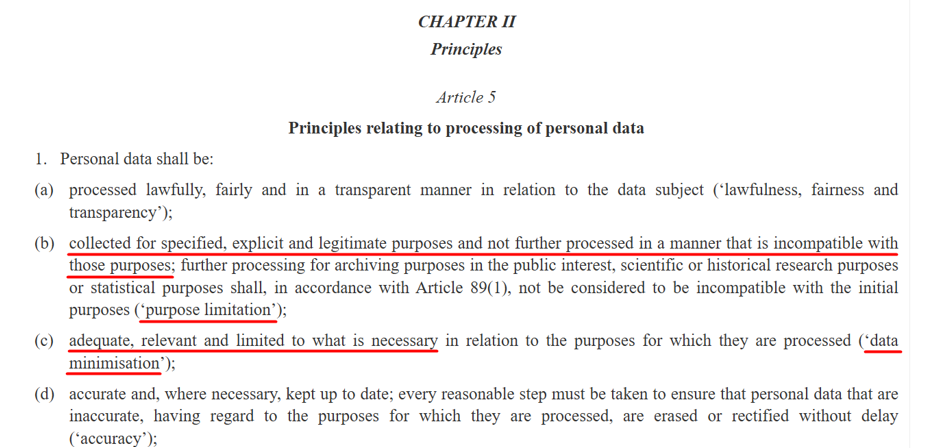
Source: GDPR
Think of it like packing a bag for a day trip. You don’t throw in everything you own just because you might want it. You pack for the actual journey. The same logic applies here.
Define what you need the data to do, collect only that, and build in a deletion timeline from the start. Regulators increasingly scrutinize data retention periods alongside collection practices. Data that’s served its purpose has no business sitting in your system indefinitely.
Consent Has to Actually Mean Something
Consent isn’t meaningful when it’s buried inside dense legal language. It isn’t meaningful when boxes are pre-checked or unsubscribing processes require detective-level investigation skills.
People should understand what they’re agreeing to. That expectation has become increasingly important as businesses collect data across websites, applications, customer platforms, and automated systems.
Regulators have also begun paying closer attention to consent mechanisms that appear designed to steer users toward a particular choice.
For teams running automated data pipelines or web scraping operations, the question of consent may look different. You’re often not dealing with a direct user relationship. That makes purpose and source legitimacy even more important, since consent in the traditional sense may not apply.
Accountability Doesn’t Stop at Data Collection
Ethical data collection doesn’t end once the data is in your system. How you store it, who can access it, and when you delete it are part of the same responsibility chain. European data protection authorities now receive 443 data breach notifications per day, a 22% year-over-year increase.
Most of those incidents weren’t the result of sophisticated attacks. They came from poor internal data hygiene, such as unnecessary data sitting in systems too long and access permissions that hadn’t been reviewed.
The organizations that handle this well treat data as something entrusted to them. That means access controls tied to actual need, retention policies that have real teeth, and audit trails that can answer regulators’ questions before they’re asked.
In a market where trust is increasingly hard to earn and easy to lose, actively applying ethical data practices is the only reliable path forward.
Key Takeaways
Ethical data collection is becoming less about compliance and more about trust. Businesses still need data to understand markets and make better decisions. What’s changing is how that information is gathered and managed.
Customers are asking more questions, and regulators are raising expectations. The organizations that stand out are those collecting data with a clear purpose, boundaries, and accountability.
As data becomes more accessible and collection tools become more powerful, ethical practices will increasingly separate companies people trust from companies they tolerate.
 Angelo Reynoldsick has opinions about expert insights. Informed ones, backed by real experience — but opinions nonetheless, and they doesn't try to disguise them as neutral observation. They thinks a lot of what gets written about Expert Insights, Effective Branding Strategies, Customer Engagement Techniques is either too cautious to be useful or too confident to be credible, and they's work tends to sit deliberately in the space between those two failure modes.
Reading Angelo's pieces, you get the sense of someone who has thought about this stuff seriously and arrived at actual conclusions — not just collected a range of perspectives and declined to pick one. That can be uncomfortable when they lands on something you disagree with. It's also why the writing is worth engaging with. Angelo isn't interested in telling people what they want to hear. They is interested in telling them what they actually thinks, with enough reasoning behind it that you can push back if you want to. That kind of intellectual honesty is rarer than it should be.
What Angelo is best at is the moment when a familiar topic reveals something unexpected — when the conventional wisdom turns out to be slightly off, or when a small shift in framing changes everything. They finds those moments consistently, which is why they's work tends to generate real discussion rather than just passive agreement.
Angelo Reynoldsick has opinions about expert insights. Informed ones, backed by real experience — but opinions nonetheless, and they doesn't try to disguise them as neutral observation. They thinks a lot of what gets written about Expert Insights, Effective Branding Strategies, Customer Engagement Techniques is either too cautious to be useful or too confident to be credible, and they's work tends to sit deliberately in the space between those two failure modes.
Reading Angelo's pieces, you get the sense of someone who has thought about this stuff seriously and arrived at actual conclusions — not just collected a range of perspectives and declined to pick one. That can be uncomfortable when they lands on something you disagree with. It's also why the writing is worth engaging with. Angelo isn't interested in telling people what they want to hear. They is interested in telling them what they actually thinks, with enough reasoning behind it that you can push back if you want to. That kind of intellectual honesty is rarer than it should be.
What Angelo is best at is the moment when a familiar topic reveals something unexpected — when the conventional wisdom turns out to be slightly off, or when a small shift in framing changes everything. They finds those moments consistently, which is why they's work tends to generate real discussion rather than just passive agreement.